
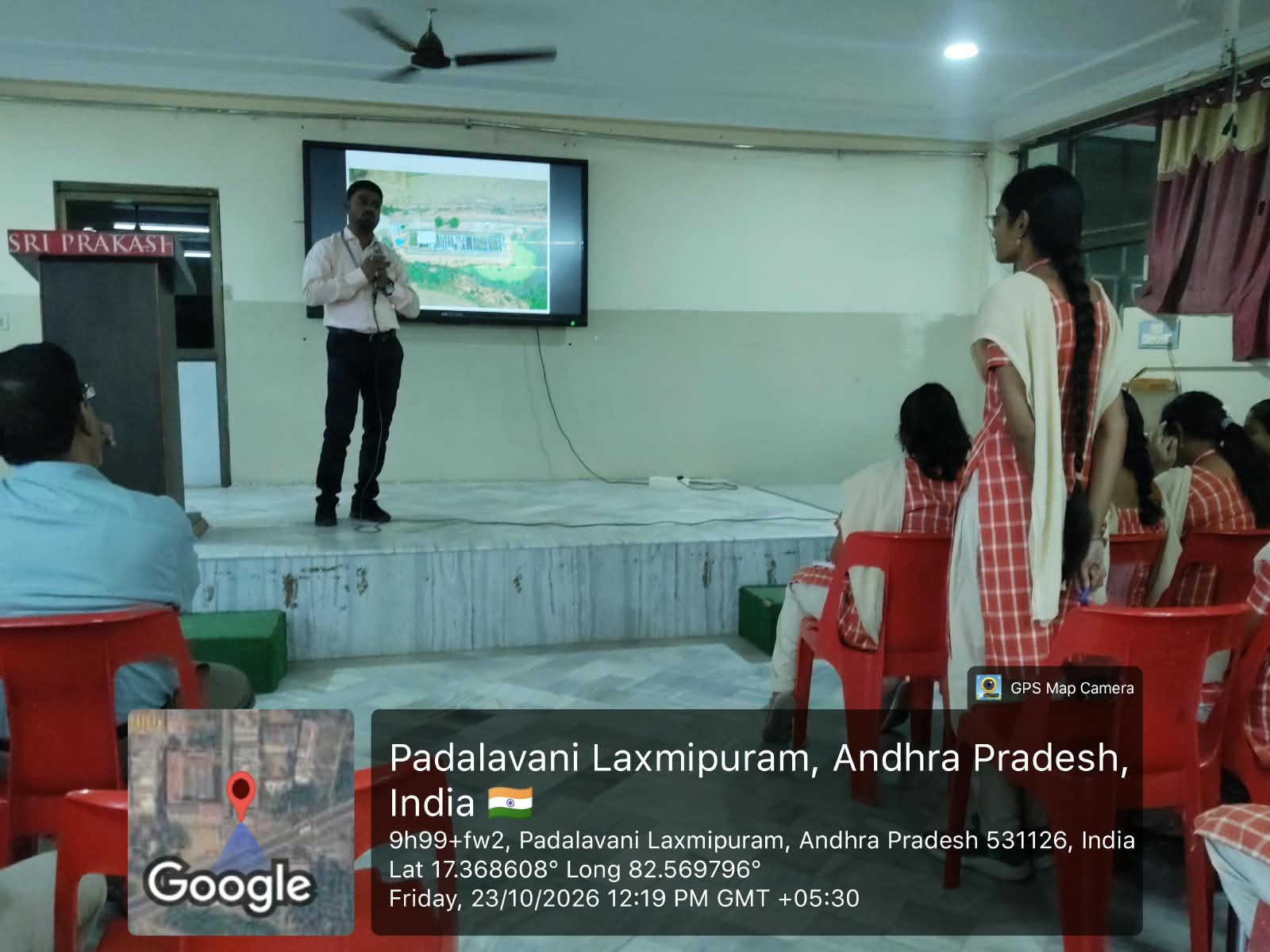
The Department of Biotechnology, SPACES Degree College (Autonomous), Payakaraopeta, organized a guest lecture on Sustainable Wastewater Treatment and Environmental Biotechnology on 23rd October 2026 as part of its academic and institutional collaboration initiatives. The session was delivered by Dr. Boda Ravi Kiran, Scientist C, Department of Energy and Environmental Engineering, CSIR–Indian Institute of Chemical Technology (IICT), Hyderabad.
The lecture focused on emerging scientific approaches to wastewater treatment, water-quality improvement, pollution control, and sustainable resource recovery. The resource person highlighted the growing challenges of water scarcity and contamination arising from urbanization, industrialization, agricultural activities, and increasing water demand. He emphasized the role of biotechnology in developing environmentally friendly solutions through the application of bacteria, microalgae, aquatic plants, and advanced biological treatment systems.
Dr. Boda Ravi Kiran introduced six major research areas that contribute to the development of sustainable environmental technologies:
1. Advanced wastewater treatment for pharmaceutical and textile industries.
2. Photosynthetic biorefineries, biofuels, and biofertilizers.
3. Bioelectrochemical systems and electrode-based technologies.
4. Sustainability assessment through life cycle assessment and techno-economic analysis.
5. Lake restoration and rejuvenation.
6. Omics technologies and computational modelling.
These research areas integrate biotechnology, microbiology, environmental engineering, and sustainable resource management to address contemporary environmental challenges.
Learning Outcomes
The guest lecture provided students with valuable exposure to the practical applications of biotechnology in environmental protection. The major learning outcomes included:
* Understanding the challenges of water scarcity and wastewater pollution.
* Learning about biological wastewater treatment using bacteria, microalgae, and aquatic plants.
* Exploring the applications of microalgae in nutrient removal, carbon dioxide utilization, biofuel production, and biofertilizers.
* Understanding the principles and potential applications of bioelectrochemical systems.
* Recognizing the treatment requirements of pharmaceutical, textile, and domestic wastewater.
* Learning about genomics, transcriptomics, engineered microorganisms, and computational modelling in environmental research.
* Appreciating the importance of lake restoration, water conservation, and wastewater reuse.
* Understanding the role of life cycle assessment and techno-economic analysis in developing sustainable technologies.
The guest lecture by Dr. Boda Ravi Kiran was an enriching academic experience that highlighted the importance of environmental biotechnology in addressing water pollution and sustainability challenges. The session provided insights into emerging wastewater treatment technologies, microalgal applications, bioelectrochemical systems, omics research, and lake restoration.
The lecture encouraged students to connect theoretical knowledge with real-world environmental applications and appreciate the importance of scientific innovation in protecting natural resources. It also strengthened awareness of research opportunities in biotechnology, environmental engineering, renewable energy, and sustainable development.
SPACES Degree College (Autonomous), Payakaraopeta, expresses its sincere gratitude to Dr. Boda Ravi Kiran for sharing his expertise and valuable insights.* The Department of Biotechnology remains committed to promoting academic enrichment, scientific awareness, research orientation, and meaningful interactions with experts to prepare students to contribute to a sustainable and environmentally responsible future.